
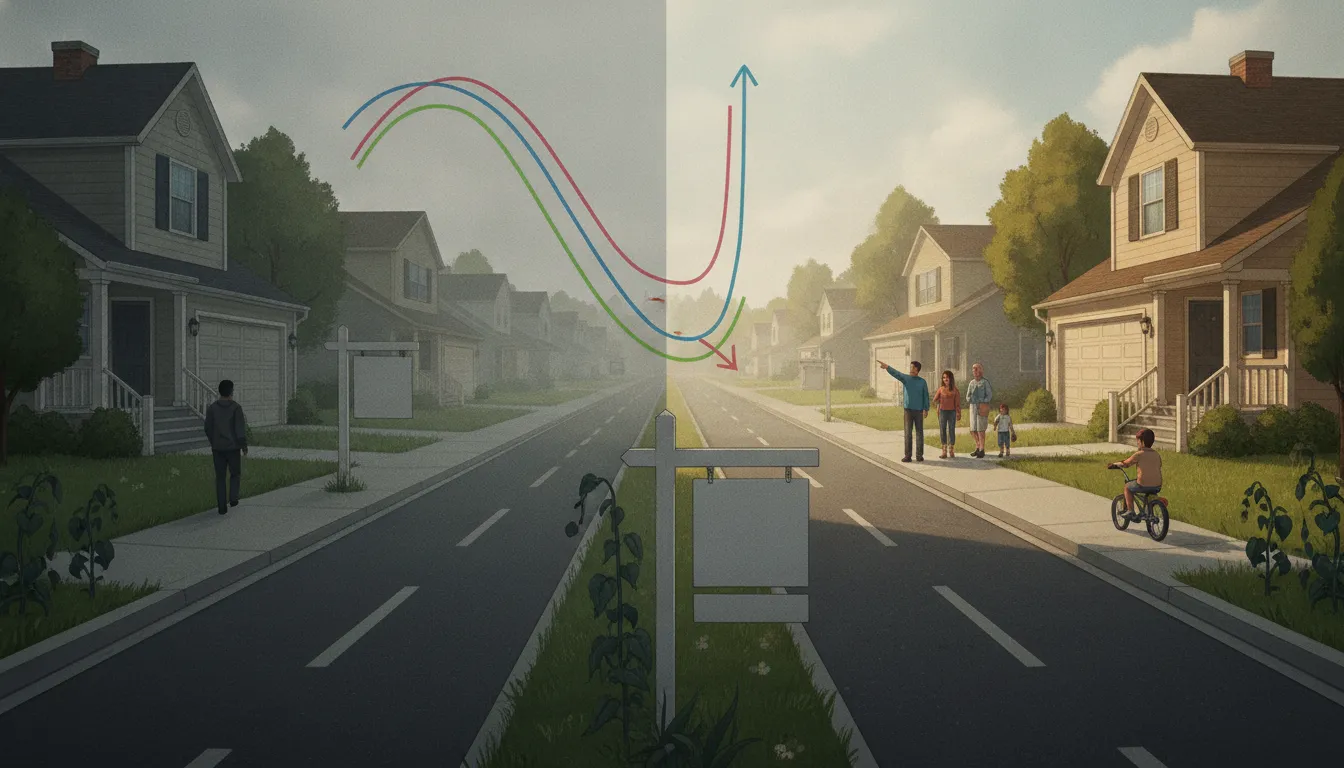
Zillow Reports a Housing U-Turn: What 40% Losses Mean for Buyers and Sellers
Zillow data shows home tours falling and some listings priced far below prior sale values as the 2026 housing market cools. Here's what the shift means for Utah buyers and sellers, and how to respond with discipline instead of headlines.

The 2026 housing market is showing a sharp split between weakening demand and rising buyer caution. In several U.S. markets, home tours are falling, online interest in homes for sale is softer, and some listings are appearing at steep discounts compared with prior purchase prices.
That does not mean every market is crashing. It does mean buyers, sellers, and investors need to read the market more carefully than they did during the fast-rising years. Some areas are seeing meaningful price declines, while others are still holding up or even increasing.
For Utah households trying to make sense of national housing headlines, the key question is simple: what does a housing market downturn actually look like, and how should a buyer or seller respond?
What the 2026 housing market shift looks like
Several signs point to a weaker summer market than many expected.
Home tours are dropping. Showing data indicates a substantial decline in scheduled tours over a short period.
Search interest is softer. Fewer people are actively searching for homes for sale, which usually signals weaker future demand.
Large listing losses are emerging. In some markets, homes are being listed far below what owners paid only a few years ago.
Affordability remains strained. Monthly ownership costs have risen enough to pressure both current owners and new buyers.
Together, these signals suggest a housing correction is broadening in parts of the country, especially where prices ran up quickly and monthly payments became difficult to sustain.
Why some homes are now selling at six-figure losses
Some of the most striking 2026 examples involve homes being offered for $140,000 to $170,000 less than earlier sale prices. These are not minor adjustments. They point to real pressure in certain neighborhoods and metro areas.
There are a few likely drivers behind losses of that size:
Buyers purchased near the peak. Homes bought at inflated prices have less room for error when the market cools.
Monthly payments became too expensive. Mortgage, taxes, and insurance costs have increased enough to strain ownership budgets.
Distressed sales are rising. Some owners are choosing short sales or discounted listings to exit unaffordable situations.
Demand has weakened faster than sellers expected. When showings slow and offers disappear, list prices often have to follow.
This matters because it changes the negotiating environment. In a weaker market, the list price is no longer the only reference point. Buyers increasingly compare the home to local competition, time on market, and monthly payment burden.
Why affordability is the real story behind the downturn
Price changes get the attention, but affordability is the deeper issue.
Ownership costs for existing homeowners have risen significantly since 2019 when mortgage, tax, and insurance expenses are viewed together. Even households that secured lower mortgage rates earlier in the cycle are still facing higher overall housing costs.
New buyers are under even more pressure because they must buy at current prices and current mortgage rates. The typical monthly payment for a newly purchased home in the national market is far above what many households consider comfortable.
That gap between what homes cost each month and what buyers are willing or able to pay is one of the clearest reasons demand is fading.
Why monthly payment matters more than headline price
A house can look cheaper on paper and still be unaffordable. The better lens is the all-in monthly cost, including:
Principal and interest
Property taxes
Homeowners insurance
Expected maintenance
For practical decision-making, many buyers focus less on list price and more on whether the payment fits their long-term budget. That approach is especially useful in uncertain markets.
Which markets are seeing the biggest price drops
Recent home value data shows regional divergence rather than a uniform national move.
Markets showing notable weakness include parts of:
Washington, including the Seattle area
California, including Silicon Valley counties
Texas, including areas north of Dallas and around Austin
Colorado, including Denver
These areas have recorded month-over-month declines large enough to imply sizable annualized drops if the trend continues.
At the same time, some places are still rising. A notable example is San Francisco County, where a concentrated tech and AI boom appears to be helping downtown housing values more than surrounding tech-heavy markets.
This uneven performance is important. It shows that buyers and sellers should avoid broad assumptions such as “housing is falling everywhere” or “real estate always goes up.” Local conditions matter more than ever.
What this means for Utah buyers
Utah buyers should not assume that national weakness automatically translates into the same pricing pattern in every Utah city. The better approach is to watch inventory, price cuts, time on market, and monthly payment pressure at the neighborhood level. This is also a good moment to revisit the warning signs that should make you think twice before buying a home, since a softer market tends to surface more distressed and poorly maintained listings.
That is especially relevant in a state where market conditions can vary widely between metro areas. Buyers comparing local trends can use Utah real estate markets to track differences in pricing, days on market, and price-cut activity across the state.
Utah has also been moving toward more buyer-friendly conditions in some segments, with higher inventory changing the balance of power. That broader shift is outlined in Utah’s buyer’s market update, and is echoed in the more detailed look at whether it makes sense to buy in St. George right now.
How buyers can use a weaker market to their advantage
A weaker market can create real opportunity, but only for buyers who stay disciplined.
1. Focus on stale listings
Homes that have sat on the market longer often indicate pricing resistance or seller fatigue. Those properties may provide more room for negotiation than newly listed homes.
2. Look for repeated price cuts
One price reduction may simply test the market. Multiple cuts can signal a seller who needs movement and may be more flexible.
3. Underwrite the payment, not just the purchase price
A lower purchase price helps, but the monthly cost is what determines staying power. Buyers should model taxes, insurance, and maintenance before making an offer.
4. Compare against recent neighborhood sales
If a listing is still priced above realistic local comps, a “discounted” home may not actually be a deal.
5. Stay within a conservative budget
One of the clearest lessons from recent losses is that overpaying for a home that stretches the budget can erase equity and create distress later.
For first-time buyers in Utah, broader financing and planning basics are covered in essential steps for first-time home buyers in Utah, and the first-time home buyer's guide to Utah real estate covers budgeting and the offer process in more depth.
What sellers should take from this market shift
Sellers need to recognize that buyer hesitation can change pricing power quickly.
In slower markets, the biggest mistake is often overpricing at the start and chasing the market down with later reductions. Buyers tend to notice stale listings, and repeated cuts can weaken a home’s position.
Smart seller strategy in a market like this usually includes:
Pricing from current demand, not past peak values
Paying close attention to competing active listings
Preparing for more negotiation on concessions or terms
Understanding whether the home can still clear the seller’s equity needs
Owners who are unsure where they stand can get a more localized pricing baseline through a free Utah home valuation and CMA.
Common mistakes to avoid in a falling or uneven market
Assuming every price cut is a bargain. Some homes are still overpriced relative to local demand.
Buying based on fear of missing out. In a softening market, patience can be a real advantage.
Ignoring total monthly ownership cost. Insurance and taxes can materially change affordability.
Assuming national trends mirror local markets. Neighborhood-level analysis matters more than headlines.
Trusting automated tools blindly. Data tools can help, but buyers still need human judgment and local market context.
How to judge whether now is a good time to buy
There is no single answer for every household. A purchase is more defensible when these conditions line up:
The payment fits comfortably within the buyer’s monthly budget
The home compares well against recent local sales
The buyer plans to hold long enough to absorb market volatility
The property has avoided the most overheated submarkets
The buyer has cash reserves after closing
If one or more of those factors is missing, waiting may be the better decision.
Why local market research matters more than ever
The biggest lesson from the 2026 housing market is that conditions are becoming more fragmented. Some neighborhoods are correcting sharply. Others are merely cooling. A few are still rising.
That makes local research essential. Buyers looking across Utah can start with Best Utah Real Estate for statewide market coverage, city pages, listings, and housing resources tailored to Utah conditions.
For broader context on national housing costs and affordability pressures, the National Association of Realtors research center and the U.S. Census Bureau housing data are also useful reference points.
Bottom line
The housing market’s 2026 U turn is showing up in weaker buyer demand, falling home tours, and increasingly large losses on some listings. That does not guarantee a nationwide crash, but it clearly signals a more fragile market than many expected.
For buyers, the opportunity is in discipline. For sellers, the priority is realism. In both cases, success depends less on broad headlines and more on local inventory, affordability, and the actual monthly cost of ownership.
Frequently asked questions
Is the 2026 housing market crashing nationwide?
Why are some homeowners taking 40% losses on their homes?
Should buyers make lower offers in a soft housing market?
Does a lower list price always mean a good deal?
How should Utah buyers respond to national housing headlines?
Keep reading
More from the blog

How Real Estate Teams Are Replacing the Solo Agent Model

Timber Cladding vs Composite Cladding: Which Is Right for You?

How to Find the Best Cooling Comforter for Your Sleep